
27/02/19
Recorded Temperature: 35 degrees
Location: J.M Ding Darling National Wildlife Refuge, Sanibel Island, FL
Time of Departure: 8:15 am

J.N. “Ding” Darling National Wildlife Refuge was created in 1945 when Jay Norwood Darling, a cartoonist was ‘instrumental’ in the efforts to prevent the sale of the lannd to developers on Sanibel island. The name changed in 1967 in honour to this conservationist and the refuge consists of a giant six thousand four hundred acres of mangrove forest, submerged seagrass beds, West Indian hammocks and finally cordgrass marshes. While two thousand eight hundred acres of the refuge are designated by congress as a ‘Federal Wilderness Area’
The aims and reasoning behind the refuge was to ensure the safeguard and enhancement on the pristine wildlife habitat, to ensure the protection to endangered and threatened species. The refuges aims are to provide feeding, nesting and roosting areas for all migratory birds that pass through ding darling and already holds a perfect habitat for well over two hundred and forty five birds.
Once entering Ding Darling we where greeted with a gentleman named Jerry who sat us down in one of the lecturing rooms, he presented us with a powerpoint which gave us background history on Ding Darling itself and how it became a refuge for wildlife

Jerry continued his lecture with information on several extinct birds such as the Carolina parakeet (Conuropsis carolinensis) which went extinct back in 1939. As well as the passenger pigeon (Ectopistes migratorius) who similtaneously passed away in the same cage as the last Carolina parakeet in 1914. He spoke about modern environmentalism and Moran and aesthetic nature preservation, such as john Muir.
After the walk we walked around some of the refuge, following the purple boardwalk, commonly used for the younger generations in helping them identify types of plants. We shortly noticed the reddish pigmentation to the water, which Jerry quickly explained that the redness was linked to the lack of oxygen supply.

While on our walk we spotted Rosetta Spoonbills (Platalea ajaja), these are the original pink bird due to flamingos only getting their pink pigmentation. These birds where perched on the mangroves.

Continuing our short walk around Ding Darling we proceeded to get back onto the buses where we headed to a beach to collect shells, creating a dichotomous key and fish identification.
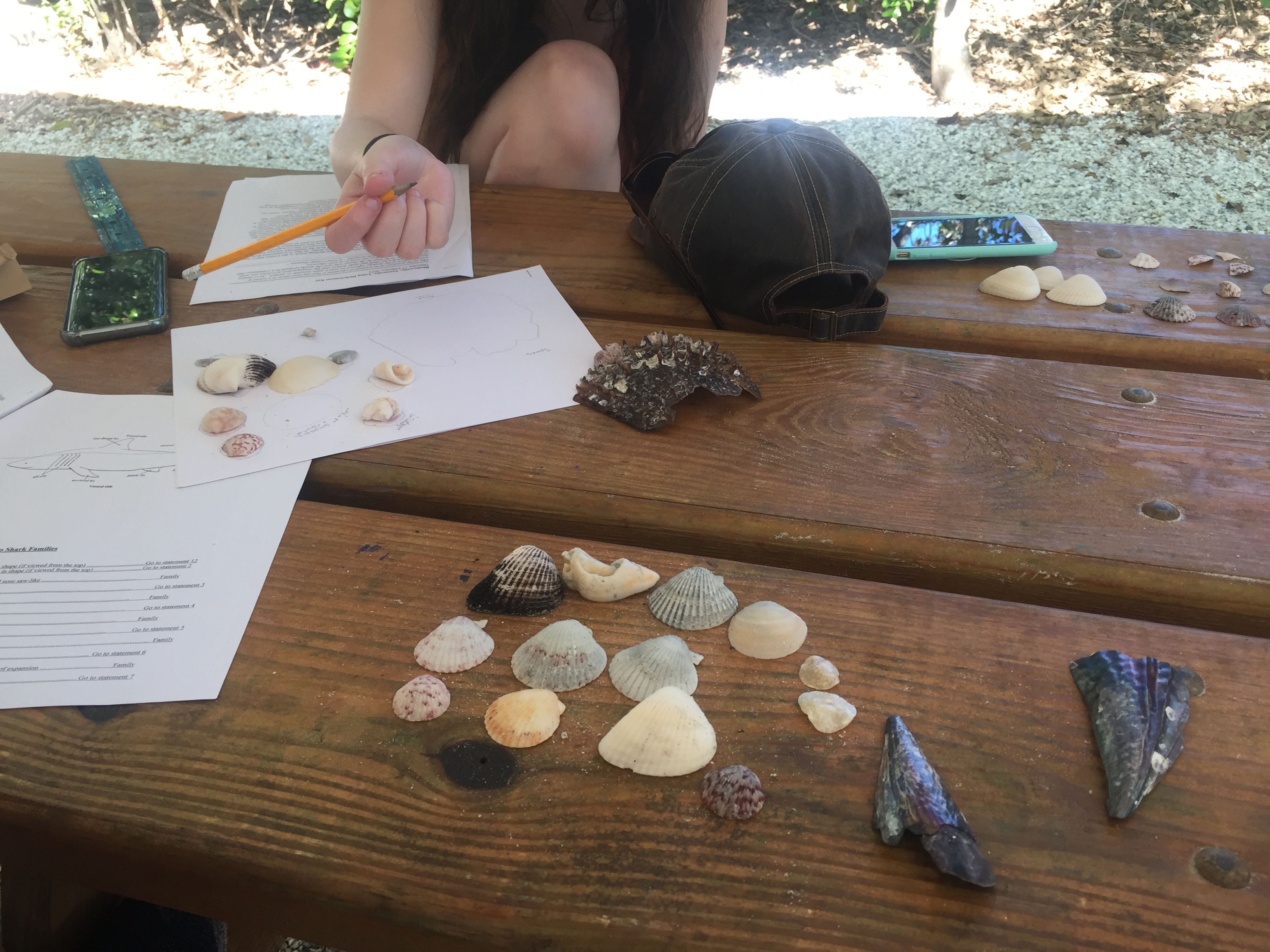
We joined with a group of college students studying marine biology where we headed out onto the beach to engage in shell collecting to allow us to do a dichotomous key. We split ourselves into small groups of four and collected a 10 shells at random alone the coastline, our group made sure our shells where predominately different in shape, size and appearance (colour and texture), this made it easier to distinguish them all.

Next we moved back onto the beach to do the fish identification, the method in which we collected the fish was seine fishing, where the net is dragged into a circular movement to trap fish in the centre. The net was dragged to land where the fish where then disbursed into 6 buckets, putting the fish of the same species into the same buckets. This had to get done quickly to reduce the mortality rates of the fish, and attempting to reduce stress as much as we could.


The Seine fishing provided a good method of collecting large populations of fish as well as a variety of different species, but throughout the duration of this particular experiment there was a significant amount of mortality rates, and ethically the data collected was not for further study, causing unnecessary stress and deaths to the fish.

Returning to Ding Darling we stayed on the buses, to drive around some of ding darling, we observed a screech owl (Megascops asio) sat high in the tree which was sleeping due to its strict nocturnal habits. As we came around the corner from that the landscape opened out into an estuary, where American White Pelicans (Pelecanus erythrorhynchos) where sat on an island far by the mangroves joined by two double-crested cormorants (Phalacrocorax auritus), tricoloured heron (Egretta tricolor) and white ibises (Eudocimus albus) just past that was a red-breasted merganser (Mergus serrator), which was washing his feathers.
On the other side of the road was mullets (Mugilidae) jumping out of the water, this behaviour is preformed to shake away any parasites that maybe on their body or potentially avoiding predators. A large school of Sheephead (Archosargus probatocephalus) fish where also present, swimming against the current. A needlefish (Belonidae) was alone also swimming against the current, close to the sheepheads.
Daily Species List and Acknowledged Behaviours –
- American white pelicans standing in a group
- Tricoloured heron perched on branch fishing
- Rosetta spoonbills perched on branches
- Red-breasted Merganser washing feathers and swimming under water
- Osprey locomotion (flying)
 Florida Wetlands 2019